Success created complexity
Orders grew, channels multiplied, and the founder became the person connecting supplier files, catalog decisions, customer needs, fulfillment, and reporting.
Fractional AI office for owner-led commerce companies
Your company is successful. The problem is that competitors are responding faster while catalog decisions, fulfillment exceptions, analytics, and approvals still route through you. Fulcrum provides the AI leadership and implementation team to change that—one proven operating loop at a time.
Choose the workflow where speed, cost, or risk matters most
Connect the right files, APIs, records, inboxes, and business rules
Set permissions, source authority, approvals, and escalation paths
Run one workflow on real data with observable acceptance criteria
Improve from outcomes and expand only when the evidence supports it
Flagship transformation
The company is successful. That is why the hidden operating debt finally matters. Fulcrum turns the founder's context, approvals, and recurring decisions into a controlled AI capability the team can run.
Orders grew, channels multiplied, and the founder became the person connecting supplier files, catalog decisions, customer needs, fulfillment, and reporting.
Competitors began responding in hours while important decisions still waited for the founder to find the context, check the risk, and push the next step.
Fulcrum mapped the business, selected the highest-value workflow, connected the authoritative systems, and built review and escalation into the operating loop.
Repeatable work moved faster, risky actions stayed reviewable, and the founder returned attention to customers, leadership, and the next growth decision.
A marketable way to start
Start with clarity. Prove one controlled workflow. Add ongoing leadership only when the business case earns it.
Find the first workflow worth funding before buying more tools or committing to a large transformation.
Build one production-shaped workflow on real data, with acceptance criteria and human control where consequences matter.
Give the company an accountable AI leader and implementation partner without assembling a full internal department.
Not every workflow should be automated. The diagnostic is valuable when the right answer is to repair the source process, keep a decision human, or postpone the build.
Start a Workflow DiagnosticControl layer
AI becomes operational when the role, data, permissions, review path, production boundary, and success measure are explicit.
High-impact actions stop at a review point where a person can approve, reject, hold, or route the exception.
The workflow shows the source values, matched records, freshness checks, and reason for the proposed output.
Rules, contracts, thresholds, and source validation run before an agent recommendation is trusted.
Writes are separated from review screens so operators know exactly when BigCommerce, FedEx, eBay, or another system changes.
Each workflow leaves proof: what ran, what was proposed, who approved it, what changed, and what stayed blocked.
Rejected or corrected work becomes structured feedback that improves the next run without hiding risk from the operator.
Operating pattern
Map the business, prove one valuable workflow, keep human approval where risk lives, and expand from measured outcomes.
Identify the files, APIs, judgment calls, approval moments, and downstream systems that make the process risky today.
Define source checks, match rules, proposal states, exception paths, and the exact boundary where a human must decide.
Operate on real data with visible evidence, logs, and review artifacts before any important write is allowed.
Use corrections, holds, and outcomes to improve the workflow, then expand only where the control loop is working.
Built workflows
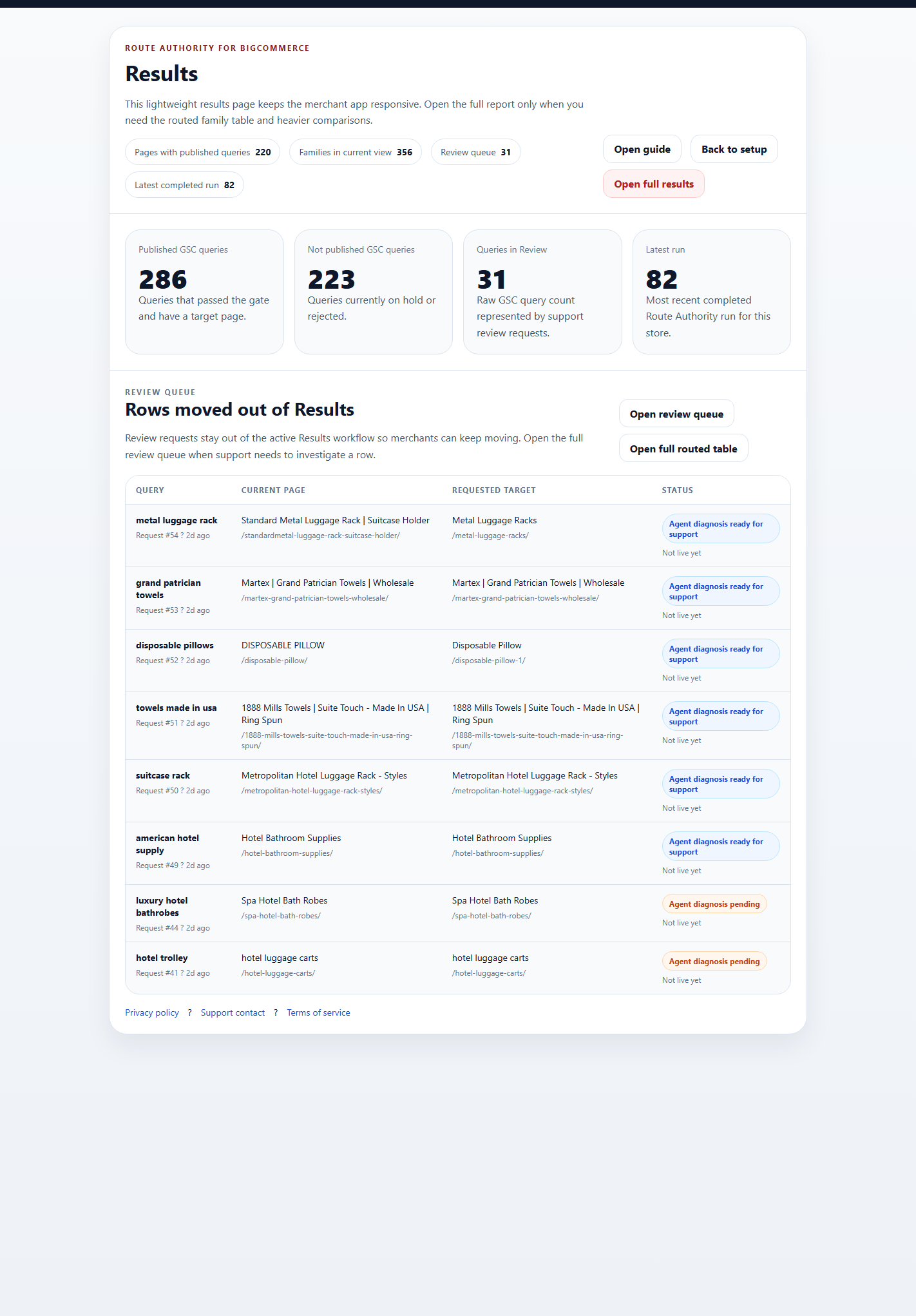
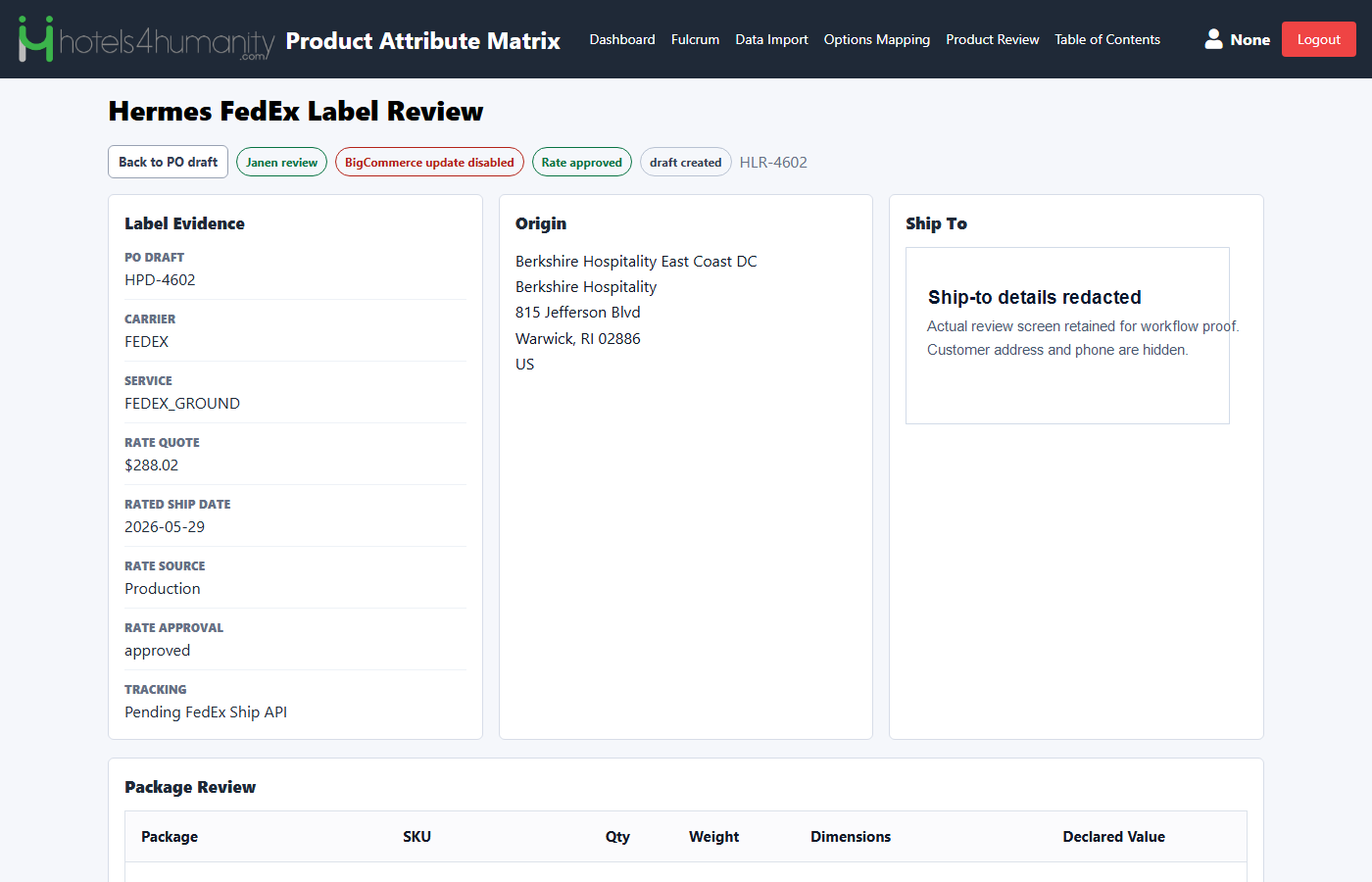
These are operating loops Fulcrum has already built: review-first, source-backed, and connected to real business systems or record sets.
Why Fulcrum
A fractional AI leader should do more than name opportunities. The work has to survive real data, API failures, exceptions, employee adoption, and the moment an approval becomes a production change.
Fulcrum combines executive prioritization with the engineering and operating discipline required to make the roadmap real. The same team maps the workflow, builds the controls, connects the systems, and measures what happens after launch.
Your people remain accountable. AI handles repeatable analysis and coordination; deterministic checks protect the boundaries; humans keep the judgment, relationships, and high-impact decisions.
Who hires Fulcrum
The pain is not access to AI. The pain is choosing where it belongs, connecting it to the business safely, and creating capacity without losing the judgment that made the company successful.
Orders, exceptions, supplier questions, pricing decisions, and approvals keep routing through the founder because the operating context lives in one head.
Competitors are answering, repricing, publishing, and following up faster while your team is still assembling the context needed to act safely.
Employees have AI subscriptions, but the tools are not connected to authoritative records, operating rules, approval paths, or measurable business outcomes.
A fast answer is not enough when the wrong action touches customers, inventory, shipping, money, or a system of record.
Best-fit buyers
How we start
The goal is not an AI demo. It is a repeatable operating capability your company can understand, govern, and improve.
Map the company priorities, workflows, data sources, failure modes, approvals, and value at stake.
Opportunity scorecard, workflow map, risk boundary, and 90-day roadmap.Ship the intake, source checks, agent proposal, operator review, production boundary, and audited output path.
A working pilot connected to the systems it must read or write.Measure outcomes, review exceptions, tighten rules, and expand automation only when the proof supports it.
Executive reporting, run logs, exception history, training, and the next prioritized workflow.FAQ
The point is not to connect everything overnight. It is to build the AI capability deliberately, prove value, and keep accountability clear.
It gives your company accountable AI leadership, implementation, governance, and ongoing operational support without requiring a full internal AI department. Fulcrum prioritizes the opportunities, builds the controlled workflows, and stays responsible for how they perform.
It includes that executive responsibility, but it does not stop at strategy. Fulcrum also provides the implementation and operating layer needed to connect systems, train the workflow, govern risk, and measure results.
A subscription gives employees access to a model. It does not decide which workflow is worth funding, establish source authority, connect company systems, create approval and escalation paths, measure value, or remain accountable when the process changes.
Not in one risky step. Fulcrum maps the whole business, then starts with one high-value operating loop. Each expansion has explicit data access, permissions, review boundaries, acceptance criteria, and an owner. The goal is a connected AI capability, not an uncontrolled super-agent.
Use those tools for isolated tasks, drafts, exploration, and code help. Hire Fulcrum when the process touches real data, customers, money, fulfillment, publishing, or another workflow where the business needs repeatability, permissions, evidence, and accountability.
Better models make demos easier and raise expectations. They do not remove the need for business process design, permissions, source-of-truth rules, accountability, human review, exception handling, and production monitoring. As AI spreads, those control layers matter more.
Yes, but not by default. High-impact writes are separated from review. A workflow can stage evidence first, require approval, and only then write to systems such as BigCommerce, FedEx, eBay, legal evidence stores, or a database.
Ambiguity is treated as a workflow state, not a failure to hide. The system can hold the row, show the conflicting evidence, recommend the right fix path, and wait for an operator decision.
No. Many useful workflows start by making bad inputs visible. The first version can classify errors, stage safe proposals, and identify the source contracts that need repair.
Bring one process that repeatedly comes back to the founder or best employee. We will discuss the systems it touches, the decision being made, the cost of delay or error, the approval boundary, and how a successful pilot would be measured.
Start with one workflow
Send the process, the systems it touches, the decision you still make personally, and what faster execution would change for the business.